Showing posts with label Henry James. Show all posts

Friday, 18 September 2020

Walking the Dog : (i) Staverton Pudding (ii) In the Valley of the Og

Staverton Pudding


‘Staverton? Oh, you mean the airport?’ Actually, no. Gloucestershire Airport – ‘Gateway to the south west’ as it proudly proclaims itself – is more than a mile from the village of Staverton (population 572) – essentially a straggle of houses along a country back road, with not a shop, pub, bus stop or school in sight. There was a school once and I’m pleased to say the rose-covered Old School House still stands. These days Dash the springer spaniel, my old friend and walking companion, lives there. Over her garden wall, what was once the official residence of the Bishops of Tewkesbury is still standing too and still called ‘Bishops House’ (the missing apostrophe a matter of regret, to me at least). Appropriately, it’s in Church Lane, and on our regular walks the churchyard of Staverton Church is always the first stop. Dash is a very good age now, and no longer romps, still less dashes, around.  Still, she enjoys sniffing around the gravestones and the ancient yew trees, and is careful to avoid trampling the cyclamen which grow wild here.


The past exerts a strong pull in Staverton: a nineteenth century obelisk marking the grave of Captain David Latimer St Clair proclaims that ‘he was of an ancient family’. Elsewhere in the churchyard another grave, a hundred years later, has as its epitaph ‘The last of his family’. Near the church porch, under the oldest of the yews, are a couple of 17th century headstones – rare in any churchyard. One has lost all its inscription but still has an opulently carved swag incorporating the arms of a Worshipful Company of the city of London:  


a field silver, a chevron sable (black) grailed and three compasses of the same.


It would good to know who it was in this remote Gloucestershire village who’d been a Liveryman of the Company of Carpenters.


Alongside, another headstone is still just legible. It records the death of John Drinkwater who ‘disliking all earthly vanities put off mortality Anno Dmi January 25th, 1675’. I wonder whether the poet and playwright John Drinkwater (1882-1937) ever found this headstone. One of his poems suggests he might have done. He loved Gloucestershire and knew this part of the county well, although he called himself a Warwickshire man:


Long time in some forgotten churchyard earth of Warwickshire,

My fathers in their generation lie beyond desire,

And nothing breaks the rest, I know, of John Drinkwater now,

Who left in sixteen-seventy his roan team at plough.

Who Were Before Me’ (1921)


Ars longa, vita brevis: that parenthesis, ‘I know’, is telling. For much of his career as a writer, Drinkwater was preoccupied by the transitoriness of individual life and the certainty that you’re a long time dead. One of my favourite poems of his, Passage, has for me more than a nod towards Yeats:


When you deliberate the page

Of Alexander’s pilgrimage,

Or say – “It is three years, or ten,

Since Easter slew Connolly’s men,”

Or prudently to judgment come

Of Antony or Absalom,

And think how duly are designed

Case and instruction for the mind,

Remember then that also we,

In a moon’s course, are history. (1919)


Though it has been locked during the time of Coronavirus, Staverton Church is normally open and when it is, the bell is still rung early each weekday morning, a village tradition dating back to who knows how long. Was this originally to signal the start of the working day or to sound the Angelus? I’ve no idea; but it always pleases me, when I am out early in the fields walking with Dash, to hear the bell’s ‘outrollings’ – that evocative word coined by Thomas Hardy in his poem Afterwards    and suggesting how the sound carries across the landscape. 


St Catherine’s is a church with a special treasure. Tucked into the tracery of the small east window is a surviving fragment of early 14th century glass. It shows the arms, head and torso of Christ Crucified, painted in colours of black and silver-grey, copper and gold, using the technique of silver-staining on a single piece of glass. The rictus of Christ’s left hand nailed to the Cross, the detailed representation of resignation on his face and the precise rendering of the bones beneath the skin of the dead body: all these details reveal a new realism that marks a decisive shift away from the earlier styles of 12th and 13th century French and British glass. Staverton is equidistant from Gloucester Cathedral and Tewkesbury Abbey, where you can see some of the finest mid-14th century glass in Europe, but you will find nothing in the windows of either magnificent building that presents more eloquently the agony of the Crucifixion.


A gate in the NW corner of the churchyard leads back onto Church Lane, which quickly becomes a farm track, hardly wide enough for the great tractors and trailers that now lumber up and down it. In earlier times, when Dash was up for anything, we would walk the full length of the lane and then across the fields towards Barrow or Down Hatherley. Nowadays, however, she prefers to enjoy a gentle wander and a prolonged sniffing session in the Orchard.


Strictly speaking, the Orchard is simply a large meadow with some twenty pear and a couple of apple trees dotted around. We enter through a kissing gate, and a right-of-way across the field leads to a style in the far corner over which I once saw three roe deer come vaulting. I love this place. The field still bears clear traces of medieval ridge and furrow cultivation; the fruit trees are tall and old, yet produce perry pears in profusion every year. There used to be over one hundred varieties of perry grown in Gloucestershire alone, and their names – Huffcap, Merrylegs, Oldfield, Green Horse and Judge Amphlett – remind me of Titania’s attendants in A Midsummer Night’s Dream  or the roll-call of country names in Edward Thomas’s poem Lob.


Truly, the earth brings forth her fruit in due season. In spring, soon after the cowslips have appeared, we gather elderflower from the hedgerows, then watch for the first signs of blackberries – will there be a good harvest this summer? A rhyme my grandmother taught me, before I was five, comes into my head:


So you’ve come to pay your bill, Berry?

Before it is due, Berry?

Your father, the elder Berry,

Was not such a goose, Berry.

But come, don’t look so black, Berry;

I don’t care a straw, Berry!


I’ve been disappointed by the blackberries around Staverton this year, but damsons and sloes have been splendid. Dash waits patiently while I pick all I can reach. At last we head back to the Old School House, where she and I say goodbye and I return to Cheltenham bearing gifts. Already our store-cupboard holds elderflower cordial and syrup, and the first bottles of sloe gin are beginning their year-long fermentation. From the kitchen, as I write this, comes the promising smell of damson jam under production. Autumn has arrived. By way of celebration, we sit down to a unique dessert: Staverton Pudding – a ramekin of baked custard flavoured with elderflower syrup and topped by damson gin jelly, served with a scoop of damson ice-cream and a small square of sponge cake soused in sloe gin. Our own harvest supper.


© Adrian Barlow


Illustrations: (i) St Catherine’s Church, Staverton, (ii) 14th century glass fragment in the E window of Staverton Church (copyright Alastair Carew-Cox), (iii) 'The Orchard’ showing the surviving rows of ridge and furrow 

Illustrations (i) and (iii) copyright author.


The first time I wrote about walking with Dash was in January 2010, when she was an irrepressible three-year-old, living in a village near Marlborough. This post appeared on World and Time, the blog I wrote while teaching at Madingley Hall, home of the University of Cambridge Institute of Continuing Education. I’m republishing the post here with (as you’ll see) an updated final paragraph.


In the Valley of the Og (January 2010)


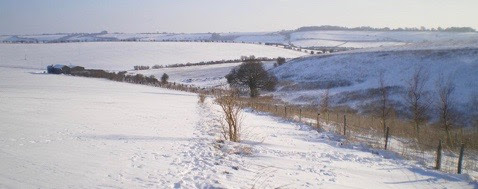
When the recent snow lay round about, at its deepest and crispest, I went walking in the valley of the Og. The Og is almost as short as its name: it rises near Draycot Foliat, a hamlet south of the M4 Swindon interchange, and approximately follows the A346 along a gap in the Downs, before feeding into the River Kennet at Marlborough. Barely ten miles, with very little ‘meandering with a mazy motion’  -  even though the last hamlet it passes en route to Marlborough is Ogbourne Maizey. It’s a marvellously resonant landscape. The valley itself is a convenient narrow fold in the Wiltshire Downs, through which passes the Roman Road that started from Winchester. Near Ogbourne St George it crosses the Ridgeway. 


From Ogbourne St Andrew you can walk over the downs to Avebury, with a view across to Silbury Hill and the West Kennet Long Barrow. Following this route is like walking through a painting by Paul Nash: you keep thinking, ‘I’ve seen this view in one of his pictures.’  


 Edward Thomas, in his book The South Country (1909), described the valley of the Og like this:


Through the grey land goes a narrow and flat vale of grass and thatched cottages. The river winds among willows and makes a green world, out of which the Downs rise suddenly with their wheat. Here stands a farm with dormers in its high yellow roof and a square of beeches round about. There a village, even its walls thatched, flutters white linen and blue smoke against a huge chalk scoop in the Downs behind.


This village is Ogbourne St Andrew, and that ‘huge chalk scoop’ is where I went walking through the snow. I wasn’t alone: there were three of us and Dash, planting our footsteps carefully in those of the person in front, for the snow was often deep enough to submerge our wellingtons. Dash, a brown-and-white springer spaniel, lived up both to her name and her breed: she dashed all over the place, leapt over the tops of hedges that now just peeped up above the snow, chased birds and rabbits before returning to her owner, trotting obediently beside her for a few yards until the call of the wild became too strong again. As I watched Dash behaving as a spaniel should, a half-remembered phrase from Shakespeare nagged at me:


The hearts 

That spaniel’d me at heel, to whom I gave 

Their wishes, do discandy, melt their sweets 

On blossoming Caesar ….


It’s Antony, lamenting the collapse of his fortunes (Antony and Cleopatra IV.x.34ff) and feeling sorry that everyone has abandoned him for ‘blossoming’ Octavius, the coming man. This is the only time Shakespeare uses the word ‘spaniel'd’; indeed, this is the only recorded use of the word in English. He is also credited by the Oxford English Dictionary with the first recorded use of ‘discandy’, but this word seems to have enjoyed a brief popularity. Still, two new words in two lines ….


Suddenly Dash reappears with a twitching, half-dead rabbit in her mouth. She drops the creature at our feet, expecting praise which she does not get. It is left to me to wring the rabbit’s neck, a job I have never done before. It takes me two goes, and I feel terrible as I hear the irreversible snap. I can’t remember ever reading an account of killing a rabbit, but I expect there’s one in The Amateur Poacher (1879), by the once-popular Victorian nature writer Richard Jefferies. Jefferies was born at Coate, a couple of miles from the source of Og. He was one of Edward Thomas’s heroes.


The Og is technically a winterbourne, a stream running through a chalk landscape and usually only full of water in winter. There are at least three Winterbournes in fiction: Giles Winterbourne in Hardy’s novel The Woodlanders, Daisy Miller’s suitor Frederick Winterbourne in Henry James’ 1878 eponymous novella, and George Winterbourne, the protagonist of Richard Aldington’s controversial First World War novel, Death of a Hero (1929). Each time, the name seems most apt.
 

Like Jefferies, Aldington is a writer who has somewhat disappeared from view; but in the years before and after the Great War he was a key figure in the literary landscape, first as poet, then as novelist and biographer. He deserves to be better remembered;* indeed, I was to be talking about him later that week at Madingley Hall during the course Report on Experience: The Great War and its Poets.  Not surprisingly then, Aldington’s fictional George Winterbourne (who gets killed on 4thNovember 1918 - the day Wilfred Owen actually died) was much on my mind as I walked amid the winter snow in the valley of my favourite winterbourne, the Og.


*Since I wrote ‘In the Valley of The Og’ in 2010, Aldington has been the subject of a significant two-volume biography by Vivien Whelpton, which has done much to restore interest in his life and work. To my astonishment, my own MA thesis, Imagism and After: the Poetry of Richard Aldington (Durham: 1975), written at a time when no one else in the UK was giving Aldington a second’s serious thought, appeared this year in the bibliography of a book which I plan to discuss in a future post, on life-writing: Francesca Wade’s Square Haunting (Faber, 2020).


© Adrian Barlow 2010, 2020; photographs by the author.


Thursday, 13 April 2017

Henry James and the Spoils of Old Place

Old Place, Lindfield in Sussex, was the home of stained glass designer Charles Eamer Kempe. He restored this Jacobean manor house, enlarging and enlarging it again, to create a stately pleasure dome that dazzled visitors and led Country Life to write about it no fewer than four times in as many years. Variously described as a House Beautiful and as a Palace of Art, its contents and its gardens reflected Kempe’s taste, his passion for art and for the past. One dazzled visitor was the sculptor and writer, Lord Ronald Gower, who wrote in his Diary for 27th September 1889:

'I paid Mr Kempe (the great artist of coloured glass) a short visit at his delightful home, Old Place, at Lindfield. This is truly a ‘house beautiful’, every room in it, even the bedrooms with their quaint old ‘four posters’, their tapestries, and stained glass windows, artistic studies one and all. [….] The outside of Old Place is as beautiful as the interior, the effect of crimson from the Virginia Creeper on the grey stone walls, crowned by picturesque gables, harmonizes with the wealth of colour within doors.'

Lord Ronald (doyen of the Aesthetic Movement’s demi-monde, model for Lord Henry in Oscar Wilde’s The Picture of Dorian Grey) became a frequent visitor to Old Place, his name appearing often in Kempe’s Visitors Book. In July 1893, when the new East wing had just been completed, he noted that ‘Old Place is now one of the prettiest places I have ever seen,’ but added  – as if reluctantly – ‘Perhaps if one could find a fault with this almost perfect house it would be that it is a little over-decorated. The new drawing room is a blaze of carved roses in scarlet and gold, with superb oak carving on the walls.’

Another visitor in the 1890s was Henry James, to whom Kempe had been introduced through his friends Field Marshal Viscount and Lady Wolseley, near neighbours in Sussex. James signed his name in the Visitors Book for the first time on 8th March 1897, and it’s tempting to think he might have had Old Place in mind when he wrote The Spoils of Poynton, his novel about a widowed lady, Mrs Gereth, who lived in an ‘exquisite old house’ full of ‘the things’, antiques collected from all over Europe with which Poynton ‘overflowed’. While writing this novel, James had provisionally titled it The House Beautiful, the same phrase Gower had borrowed for Old Place from Pilgrim’s Progess. Clearly, Lord Ronald had thought Old Place overflowed; he would also have agreed with James’s description of the house as ‘early Jacobean, supreme in every part, a provocation, an inspiration, the matchless canvas for a picture’.


Kempe’s friends would have had no difficulty in recognizing what James meant when he said that Poynton was

the record of a life. It was written in great syllables of colour and form, the tongues of other countries and the hands of rare artists. It was all France and Italy, with their ages composed to rest. For England you looked out of old windows – it was England that was the wide embrace.

The windows of Old Place too offered a vision of England – and explicitly of early 17th century England: rose garden, yew walks, sundials.  When in 1885 he held a grand garden party, Kempe opened the gates ‘to all who would see the England of their forefathers’, he and his friends dressing up in period costume to add to the atmosphere. A photograph taken on the occasion shows them sitting, rather self-consciously, as if for an amateur production of Twelfth Night.

Surely, then, Old Place must have been the model for Poynton? Much as I’d like to say so, I cannot be sure, for the novel was actually written between 1895 and early 1896, and I have as yet no proof that James visited Old Place before 1897. In any case, James preferred to work from a ‘germ’, a single fleeting idea taking root in his imagination and lying dormant until he was ready to let it develop. He did not want to be burdened with too many external facts as he planned his stories. I think it likely that he’d heard about Old Place, probably from the Wolseleys, but deliberately abstained from going there until the book was written. Poynton, as he describes it, is simply James’s idea of a House Beautiful stuffed with ‘things’, not Kempe’s.

I’ve been writing about Old Place myself, for my book on Kempe. I can’t help feeling, though, that it belongs more to the world of fiction than biography. And I’m not the first to have thought this.  In Kempe’s lifetime Hugh Benson, the Roman Catholic convert son of Archbishop Benson of Canterbury, wrote By What Authority? (1904) an historical novel partly set in a house directly modelled on Old Place. More recently, David Smith’s Love in Lindfield (2016) updates The Spoils of Poynton, setting the whole story in and around Kempe’s home.

The BBC once serialised James’s novel; in Smith’s story one of the central characters is scouting for locations for another BBC adaptation. Smith is careful not to imply that Old Place was Poynton, but he makes great play with the idea that since Henry James had been friendly with a number of Kempe’s friends who were avid collectors themselves, one of them could have been the model for Mrs Gereth. This is especially true of Viscountess Wolseley; Smith correctly points out that some of her ‘things’ had been literally spoils of war, brought back from distant corners of the Empire by her husband, the Field Marshal (Garnet Wolseley, lampooned by Gilbert & Sullivan as ‘the very model of a modern major general’). 

Kempe isn’t a character in the novel, but he is a haunting, ambiguous presence in it. Appropriate, you might say, for someone who slipped effortlessly between the 17th and the 19th centuries, and who, shortly before his death, even had himself photographed as the Ghost of Old Place.


[Illustrations: (i) Old Place, the East Wing (1891); (ii) the gardens and sundial of Old Place - a glass transparency (c.1908) (iii) C.E. Kempe photographed as a ghost (1907). 

All photos © copyright The Kempe Trust 2017. 

Notes:
  • Old Place is now divided into three private houses, with no public access.
  • My forthcoming book, Kempe: the Life, Art and Legacy of Charles Eamer Kempe, is due to be published by Lutterworth Press in 2018.

Tuesday, 30 December 2014

On F.R. Leavis (ii): a close shave

(The following discussion is a continuation of my previous post, On F.R. Leavis (i): Dangerous Driving.)

Ray’s Barber Shop in All Saints Passage used to be a Cambridge institution. I only went there once, but Ray greeted me cheerfully and, after chatting for a few minutes, suddenly said, ‘I believe, Sir, you may be an English teacher.’ Disconcerted, I admitted this was true. ‘Don’t worry,’ said Ray, ‘I can always tell. Lots of English teachers come to me. Can you guess my most famous teacher? Dr Leavis himself!’ Ray waited to see how I would react to this news, before continuing, ‘Yes, he always came here. You’re sitting in the very chair he sat in. And this, Sir,’ he added, suddenly brandishing an ancient barber’s cut-throat, ‘is the very razor which I shaved him with!’

Leavis was himself a Cambridge institution. As Clive James wrote in Always Unreliable,  ‘He was part of the landscape. You became accustomed to seeing him walk briskly along Trinity Street, gown blown out horizontal in his slipstream. He looked as if walking briskly was something he had practised in a wind-tunnel.’ He was usually tieless, in an age when open-necked shirts were frowned upon, unless you were wearing a cravat. He had grown up in Cambridge, gone to school and university there, and spent virtually his whole life teaching at Downing. So why had he said, when I interviewed him, that he was ‘an outsider in Cambridge now’ and that he had ‘never really belonged there’?

Biographers and critics have often suggested that Leavis saw himself as an exile; and if an exile is someone who has to leave his native home (voluntarily or otherwise) because he cannot in conscience reconcile himself to the prevailing climate – political, cultural, religious etc. - this seems to me to describe Leavis’s position precisely. He was simply never comfortable with Cambridge University and its English Faculty, or the literary establishment at large.  His stance was always oppositional, though he believed that the business of criticism was, in one of his favourite phrases (borrowed, with acknowledgement, from TS Eliot), ‘the common pursuit of true judgment’:

‘ "The common pursuit of true judgment": that is how the critic should see his business, and what it should be for him. His perceptions and judgments are his, or they are nothing; but whether or not he has consciously addressed himself to co-operative labour, they are inevitably collaborative. Collaboration may take the form of disagreement, and one is grateful to the critic whom one has found worth disagreeing with.’ (The Common Pursuit, Preface)

‘Collaboration may take the form of disagreement’: this is the key to Leavis’s dialectical method. He came to believe that the essence of Cambridge lay in a willingness to say ‘Yes, but …’, questioning everything as a way of challenging intellectual complacency. This complacency was for him the cardinal sin into which British academic life had strayed, and outside academia he also found it everywhere embodied by England’s literary establishment: the BBC, the newspapers, and professional bodies such as (I’m sorry to have to say) the English Association (EA). He greatly admired Henry James for turning down, in 1912, an invitation to become chairman of the EA. Reading Leavis’s account of this in Scrutiny, (vol. XIV, 1946) you can hear him cheering James on when the novelist replies to the Association, ‘I am a mere stony, ugly monster of Dissociation and Detachment’.  This was Leavis, too.

As often happens with exiles, Leavis acquired a certain glamour among those who admired his principles and shared his contempts. I suspect he played up to this a little; at least it enabled him to claim of himself, his wife Q.D. Leavis and their collaborators on Scrutiny, that ‘We were – and we knew we were – Cambridge – the essential Cambridge in spite of Cambridge’. He even had a definition of what ‘we’ meant in this context: in an Appendix to his Clark Lectures, delivered in 1967 and published two years later as English Literature in our time and the University, Leavis described ‘we’ as ‘a suitably indeterminate word, suggesting as it does the unofficial, informal and non-authoritative’. And true it is that this unofficial group of exiles (‘No pupil of mine was ever appointed to a post in the Cambridge English Faculty’ he once claimed with a combination of outrage and satisfaction) came to exemplify an approach to English that teachers, sixth-form pupils and university students would learn to think of as Cambridge English.

I have to admit that, rather than Leavis’s own best-known texts (The Great Tradition, Revaluations, et al.), it was books such as L.C. Knights’ Explorations (1946) and, from a generation later, David Holbrook’s English for Maturity (1961) which gave me a keener sense of what the study of English Literature could be; of why close reading is a creative and ‘re-creative’ as well as critical activity, and of why teaching literature is an important vocation. But these convictions had first been articulated by Leavis and, long after he had sat to be shaved for the last time in Ray’s Barber Shop, they continued to animate some of the best English teaching in schools and HE departments. Do they still?


It has always been my instinct to distrust people as aggressively confident of their own opinions as Leavis was; and many of his dismissive judgments about writers seem to me at odds with the idea of a common (i.e. collaborative) pursuit of true judgment.  Here, though, I must pause and reply ‘Yes, but…’ to my own judgment, for I want at least to say, unambiguously, that Leavis’s conception of English as ‘a discipline of thought’ should still resonate wherever the teaching of English is taken seriously. It’s time, too, to acknowledge that Leavis was the first academic in England to recognize Eliot and Lawrence as writers of ‘major creativity’ whom English studies could not ignore if English was to be taken seriously. Who else of his generation could have written New Bearings in English Poetry? It was published in 1932, the same year his wife, Q.D. Leavis, published Fiction and the Reading Public?  1932 was also the year in which together they launched Scrutiny. From then until his death he believed as he made clear in the lecture I attended as a naïve undergraduate that universities must strive to become ‘anti-academic’ in order to regain their status as true creative centres of civilization’. By anti-academic he meant outward-facing, not inward-looking; self-critical, not complacent.  He insisted, above all, that you cannot be really thoughtful about literature if you are not, at the same time, thoughtful about life. I am surprised, but glad, that it has taken the rediscovery of my interview with him so long ago to make me, at last, say plainly why I think he still matters so much.

Adrian Barlow


I have written about F.R. Leavis before: