Showing posts with label Philip Larkin. Show all posts

Monday, 1 May 2023

At Cheltenham Jazz festival: ‘the natural noise of good'


'I rather like being on the edge of things’, says Philip Larkin at the start of a BBC Monitor programme, Down Cemetery Road, made in 1964. You certainly couldn’t imagine his ever saying, “I rather like being in the swing of things”. On the other hand, of swing, in terms of jazz , he was a passionate advocate. He loved ‘The wonderful music that swept the world during the first half of this century [he was writing in 1970], so wonderful that it sang songs about itself (‘Everybody’s Doing It’, ‘It Don’t Mean a Thing If it Ain’t Got That Swing’)’.

I thought of Larkin when on Saturday, the only sunny day of last weekend, I walked down the road to see what was going on at my local Jazz Festival. Montpellier Gardens, usually quiet and quintessentially Cheltenham, was transformed. A huge blue-and-white big top dominated the scene, but the crowds were all outside the tent, encamped for now in front of the Free Stage: families with very small children claiming what space they could with picnic rugs and baskets; the old – and there were plenty of us there as well – commandeering the few seats scattered around. Everyone else stood, talking, listening to the music, enjoying themselves just by being there.

I retreated to the Bandstand, which was quieter and cooler. (It was from there that I took the photo above: a panoramic image which, somewhat unnervingly, uncoils the wrought-iron circular balustrading of what claims to be one of the earliest bandstands in Britain.) A couple who had also sought the shade asked me what music I had come to hear. Ah, I explained, I hadn’t actually come for the music –  realising as I said it how absurd that sounded. ‘I just like to see people enjoying themselves.’ It was true: there’s something slightly intoxicating about a scene – especially an outdoor scene – where everyone is simply being happy. The couple smiled. ‘Enjoy’, they said.

En joie’. Jazz, his kind of jazz, gave Larkin joy. Twenty years ago, Tom Courtenay did a one-man show about Larkin called Pretending to be myself. The stage was cluttered with packing cases and odd pieces of furniture: Courtenay (who had devised the show himself) set the play on the day in 1974 when Larkin had regretfully moved out of the flat he’d lived in almost since he had become Librarian at the University of Hull. Centre stage was an aged radiogram with, around it, some of Larkin’s record collection.  Courtenay, who looked nothing like Philip Larkin but moved and stood and blinked exactly as Larkin used to do, chose a record and put it on. Sidney Bechet. As the music played, Larkin started to sway, very slightly and never moving his feet. When  the music stopped, he stopped too, and a great smile broke across his face. He just stood and stood there, beaming and absorbed in his own happiness:

On me your voice falls as they say love should,

Like an enormous yes. My Crescent City

Is where your speech alone is understood,


And greeted as the natural noise of good …. (For Sidney Bechet)


I have always admired Tom Courtenay as an actor, and never more than in that moment.

Before I became a teacher, I doubt if I had read much of Larkin’s verse except for ‘Church Going’.  But in my first year High Windows was published and in my second I taught The Whitsun Weddings as a set text. Larkin’s poetry has lived with me ever since. Towards the other end of my career, I was invited by the Larkin Society to give a lecture in Hull at a conference for teachers teaching Larkin. I chose to talk about what jazz had meant to him and how this was reflected in his own writing of, and about, poetry. I started by trying to dispel the image of Larkin as an irredeemably miserable man:

Few things have given me more pleasure in life than listening to jazz. I don’t claim to be original in this: for the generations that came to adolescence between the wars jazz was that unique private excitement that youth seems to demand. (‘Introduction to All What Jazz’)

That first sentence (‘Few things ….’) is echoed over and over in his writing and talking about jazz. I explained to my audience at Hull, that when he had been a guest on Desert Island Discs, Larkin had chosen two records by singers from the Thirties, Bessie Smith and Billie Holiday. He’d chosen Bessie’s song ‘Down in the Dumps’ because (as he explained to Roy Plomley ) in spite of its title ‘She sounds so full of life and, as she says, vitality’; he chose ‘These Foolish Things’ because, although ‘I always thought that the words were a little pseudo-poetic, Billie here sings them with such a passionate conviction that I think they really become poetry.’ When asked at the end of the programme which of his eight records he would choose if he were only able to take one, he replied, ‘It would have to be one of the jazz records. I can’t live without jazz.’ 

It is interesting, and perhaps revealing, that Larkin wrote so rarely about ‘that unique private excitement’, jazz, in his poetry. This might suggest that he wanted, consciously or otherwise, to keep these two key areas of his life separate. But on the rare occasions when the two come together, the effect can be almost overwhelming. So I went on to compare and contrast Larkin’s bleak but evocative poem ‘Reference Back’ (‘The flock of notes those antique negroes blew / Out of Chicago air’) with his private ode to joy, ‘For Sidney Bechet’Both are fine poems, each repaying the reader’s careful attention, and proving Larkin’s point that ‘at bottom poetry, like all art, is inextricably bound up with giving pleasure’. And when he said ‘like all art’, he was talking about jazz – jazz as he expresses it in poetry: ‘the natural noise of good’.

© Adrian Barlow

All quotations above about jazz come from Philip Larkin’s two collections of essays, interviews and reviews, Required Writing (1983) and Further Requirements (2001), both published by Faber.

Illustration: the Cheltenham Jazz Festival 2023, as seen from the Bandstand in Montpellier Gardens.

I have written about Larkin before:

Re-reading Julian Barnes: on poetry and ‘the poet’

Sunday, 3 July 2022

Poetry, Cultural Vandalism and the Brokers of our Heritage


It’s a long time since I had any connection at all with GCSE English.* But I have been shocked by recent headlines in (for instance) the Times (23.vi.22): ‘GCSE removes Wilfred Owen and Larkin in diversity push’ and the response from the Education Secretary, Nadhim Zahawi, as reported in (again, for instance) the Sun (same day): ‘Slamming the clearout of white writers, Mr Zahawi fumed: “Larkin and Owen are two of our finest poets. Removing their work from the curriculum is cultural vandalism. Their work must be passed on to future generations.”’ Speaking for myself, I am not shocked by the idea that students for the next few years may not encounter ‘An Arundel Tomb’ or ‘Anthem for Doomed Youth’: GCSE and A level Literature syllabuses used regularly to rotate texts and authors – and should still do so. What shocks me is the assumption that, unless a poem is prescribed by a syllabus, pupils will never encounter it.

No syllabus can include everything, nor is it the job of an exam board to focus only on ‘our finest poets’. It has always been part of English teaching to go beyond the syllabus, to teach students of any age how to explore, enjoy and value literature in English for its own sake – especially, I would add, recent literature. Teaching literature is anyway not about teaching what to read, but how to read. And this is a lifetime’s study. 

What the Times described as a ‘diversity push’, Michael Deacon in the Telegraph (25.vi.22) has not scrupled to call ‘a woke outrage’, as if the crime of culling Larkin and Owen has been compounded by replacing them with internationally recognised writers such as the Ukrainian-American poet, Ilya Kaminsky and the Somali-British poet Warsan ShirePace Deacon, these are not ‘extremely minor’ writers who have been ‘chosen purely for the sake of “inclusivity”’.  

There is nothing new, and should be nothing shocking, about mixing familiar and less familiar poets in poetry anthologies. Philip Larkin’s own Oxford Book of Twentieth-Century English Verse (1973) included many poets whose names have not entered the canon, and as Peter Porter wisely said, reviewing Larkin’s anthology for TLS: ‘Just about every name omitted, and even more each name included, will seem to the brokers of our heritage a shameful selling-short or a ridiculous marking-up’.1 More than this, however, one of the jobs of an anthology is to help readers (including journalists) understand that literature is an ongoing conversation between writers and readers across cultures, ages and languages. 

Thirty years ago, Cambridge University Press published an anthology aimed at encouraging GCSE and A level students in the UK to read ‘canonical’ British poetry from Shakespeare to Sylvia Plath plus poetry by younger and less established writers. These poems were designed to be read alongside poetry written in English by poets from America to New Zealand and from Africa, India and South-east Asia. Actually, the anthology was primarily aimed at students world-wide who, studying English Literature for exams such as IGCSE, could compare the work of their own poets writing in English with that of specifically British poets. 

At a time when poetry books for schools tended to have rousing titles such as Touched With Fire, this anthology was entitled The Calling of Kindred.2 There were 95 poets represented, of whom more than one third were not British-born writers. Larkin was included, but not Wilfred Owen. Isaac Rosenberg, however, was; so were two Second World War poets: Keith Douglas and John Pudney. There was even one poem from a recent conflict: Anthony Conran’s magnificent ‘Elegy for the Welsh Dead, in the Falkland Islands, 1982’.  

Many poets were represented by more than one poem each but only Shakespeare and Thomas Hardy had three. The poems were grouped in five sections, but not by country, theme or date. Students were encouraged to make their own connections between poems, though some suggestions were included in the notes on each poet at the end of the book. 

Putting together an anthology can be tricky. I learned the hard way: The Calling of Kindred was my first attempt, and the first – though happily not the last – of my books for C.U.P. It has sat quietly all these years on my shelves, still bringing in a diminishing (but gratefully received) annual royalty; I had not opened it for ages, until this row about GCSE poetry and diversity broke out. Comparing my book now with the controversial OCR anthology, I’m confident that on diversity and inclusivity mine scores the more highly. Woke was I, avant la lettre? Back in 1993, nobody batted an eyelid.

Poetry anthologies tend not to get reviewed, but mine was. The poet John Mole, writing in the Times Educational Supplement, kindly described the book as ‘Like all the best anthologies, a personal choice without fear or favour’. He was generous, too, when he added:

Although The Calling of Kindred is strong on the established canon, what makes it exceptional is the skill with which the editor mixes these with his own discoveries, many of which are by young writers who are not British-born. A real sense of the English-speaking community is established, and the anthology’s title (taken from a poem by the Welsh poet Ruth Bidgood) suggests both intimacy and long-distance communication.3

In the book’s Introduction I wrote that ‘Kindred spirits are those with whom we feel we have much in common. Poetry is written, spoken and read in English all round the world, and poets and readers are a diverse but also a closely-knit family.’4 After fifty years of teaching, talking, and writing about writers, I believe more strongly than ever in the idea of ‘the community of literature’ and of helping readers of any age to feel they can belong to this community.

© Adrian Barlow

Notes:

*To be clear: I taught O level, GCSE and A level English Literature from 1973-1997; I was closely involved in GCSE, A level and international curriculum and syllabus development from 1985- 2005. I was OCR Staff Chair of English and Classical Subjects 2000-2005.


1. Peter Porter: ‘A Quiet Revolution’ (Times Literary Supplement, 13.iv.1973)

2. Adrian Barlow: The Calling of Kindred: Poems from the English-speaking world (Cambridge 1993: Cambridge University Press)

3. John Mole: ‘Speaking for themselves’ – review of The Calling of Kindred (Times Educational Supplement, 14.x.1994)

4. The Calling of Kindred, Introduction, p.6


I have written before about Wilfred Owen, in ‘Jon Stallworthy and Wilfred Owen’s Ghost’ (2014) and about Philip Larkin in ‘Re-reading Julian Barnes (ii): on poetry and ‘the poet’ (2012).

Sunday, 19 June 2022

Alan Bennett’s Journey Home


Alan Bennett’s books come in three sizes: large and fat, tall and slim, or squat and thin. His three volumes in the first category - Writing Home (1994), Untold Stories (2005) and Keeping On Keeping On (2016; hereafter KOKO) – between them number over 1,900 pages. His plays, as published individually, are tall and slim; of those on my shelf, only The History Boys (2004) exceeds 100 pages. We usually associate slim volumes with poetry, none slimmer than Philip Larkin’s. Bennett, it’s no secret, is a great fan of Larkin. In the Introduction to KOKO, he tells the reader that when trying to think of a title for his new book, he picked up The Whitsun Weddings (1964; 43 pages), but was at once discouraged:

‘at eighty-one I’m still trying to avoid the valedictory note which was a problem Larkin never had, the valedictory almost his exclusive territory.’ 


Understandably for someone who will be ninety in two years’ time, there is something valedictory about Bennett’s latest book, House Arrest (2022), which definitely comes into my third category, squat and thin: it has only forty-nine pages and slips easily into one’s pocket. (I have been carrying it around and re-reading it for the past two weeks; if it was the one book I could take to my desert island, there’s a fair chance I might learn it all by heart.) House Arrest is subtitled ‘Pandemic Diaries’ and a monochrome painting by Jon McNaughton of Alan Bennett’s desk and study window prefaces the diary entries. It shows a room in deep shadow, the window blind lowered, the desk lamp off and the desk chair displaced by a low table. Desk and table are covered by neat stacks of papers and books, as if someone has had to come and tidy up the sheets of work(s) in progress that will now never be completed. A half-typed page sits inconclusively in the typewriter. 


Facing this frontispiece is an epigraph from ‘Staring out of the Window’ (2001), an essay in which Bennet suggests that the work for which writers really deserve recognition should be the endless time spent staring out of the window, searching for something to say or struggling for a better way to say it. Bennett sums up the argument of that essay, whose title perhaps nods towards Larkin’s High Windows (1974; 42 pages), thus:


The real mark of recognition for a writer or any artist, perhaps, comes when the public wants him or her to die, so that they can close the book on that particular talent, stop having to make the effort to follow the writer any further, put a cork in the bottle.


Now, in House Arrest, he condenses that idea dramatically:


4 September (2020): What your work does is ‘tell people you’ve been alive.’ Lucian Freud.


Bennett is still very much alive, though suffering these days from arthritis and no longer able to ride his bike. Happily, he finds the pandemic and the prospect of ‘static semi-isolation scarcely a hardship or even a disruption to my routine’. Indeed, he faces the indefinite sentence of house arrest with complete equanimity. Reflecting on the new threat of Covid, he recalls that when he was a child fear of catching TB was the major anxiety: his mother’s determination that he should always keep his neck warm is the reason why, to this day, he is never without a tie. Clothes feature frequently in his diary entries: his mother’s ‘swagger coat’; his father’s two suits (both navy blue, one for best and the other worn every day in the butcher’s shop); army civvies, ‘ill-fitting, itchy and unbecoming’. He is shocked to see the Queen now wearing protective gauntlets instead of her traditional white gloves and dreads the thought  she might next appear in full PPE. 


Hands and hand washing, appropriately, feature too. Recalling how his mother was ‘Always one to diddle her hands under the tap,’ he comments that she would ‘have found the precautions against the coronavirus only common sense.’ On Good Friday he notes that ‘this year Pontius Pilate is not the only one washing his hands’. He admits he’s never much liked his own hands; now, ‘much washed’, they appal him: ‘shiny, veinous and as transparent as an anatomical illustration.’ 


I did not know how much junk shops mattered to him – ‘Lures they were in the sixties, junk shops’ – and he has fond memories of Mrs. Hill’s kitchen shop in Kirby Stephen, which (as he has previously explained in KOKO) sold ‘what these days is dignified by the name of kitchenalia’. Bennett has had a lifelong affection for marginalia, real and metaphorical, and you can sense his contempt for this undignified neologistic noun. Later, he is dismayed to find that a second-hand bookshop in Settle (‘a lovely shop full of unexpected treasures and absurdly cheap’) has closed for good, not just for Covid. The sense of loss, of times and places irrecoverable, of people much missed, runs insistently through this little book.


No less insistent is the idea of home. Bennett describes himself, accurately, as a ‘denizen’  (an outsider who becomes a resident) of London for most of his writing life, and records with no small pleasure the discovery that a fellow diarist, the Rev Francis Kilvert, once visited 23 Gloucester Crescent, previously Bennett’s own house. But it’s Yorkshire, of course, that is really home, and House Arrest ends with lockdown lifted and Bennett heading north at last. His route from Leeds across Wharfedale and up almost across the Pennines is one I know well: Spen Lane, Otley Road, Ben Rhydding, Ilkley, Bolton Abbey, Skipton and on. And now, after reading his Pandemic Diaries, I shall always imagine Alan Bennett not as actor, man of letters or national treasure but, improbably, as a ‘soldier on Coronation leave in 1953’ clambering up Ingleborough, one of the Yorkshire Three Peaks. Looking down, he can see the village  below to which his parents retired in the 1960s and which, ever since, has been his true home too.


© Adrian Barlow


Illustrations: (i) Alan Bennett’s new book, House Arrest, published 2022, alongside a work by the ceramic artist Janine Roper; (ii) the epigraph and frontispiece of House Arrest

Phototographs © the author.


I have written before about Alan Bennett: 

‘So teach us to number our days': diaries and diarists

Alan Bennett  and Tennyson in Poets' Corner

Wednesday, 11 August 2021

To Norfolk (again)

‘I grow old … I grow old … I shall wear the bottoms of my trousers rolled’: thus TS Eliot’s Prufrock, and I know how he felt. These days, seaside holidays provoke in me two contrasting emotions: nostalgic indulgence in old memories (mostly of Sidmouth in early youth) tempered by the graceful acceptance that as a grandparent my role now is to sit quietly on the beach unless required (a) to assist with making sandcastles, (b) to admire the sandcastles made without any help from you, grandpa, (c) to act as lifeguard when paddling occurs, (d) to be on hand to buy ice-creams, fish & chips or crab sandwiches when time and circumstance  demand.

 Philip Larkin sums all this up perfectly with his account of ‘the miniature gaiety of seasides’, in ‘To the Sea1. I believe this was the second Larkin poem, after ‘Church-Going’, I ever read and I’m still struck by the evident pleasure he took in returning to one of the few scenes of his childhood remembered with evident affection. 


It’s entirely appropriate that John Sutherland’s recent biographical memoir, Monica Jones, Philip Larkin and Me: Her Life and Long Loves (2021) should have on its front cover a photo of Larkin and Monica enjoying (or not?) a morning on the rocks, probably at Sark in the Channel Islands, where they used to go for what was ‘half an annual pleasure, half a rite’. He stands staring out to sea, wearing a Harris tweed sports jacket and grey flannels. Monica, looking like Catherine Deneuve on a bad day, sprawls on the ground with her back to him, reading the Daily Telegraph through dark glasses. I wonder who was with them to take the photograph?

 We have just spent a week in Norfolk.2 We weren’t exactly beside the seaside, for we stayed in a holiday cottage on the Norfolk Broads, a few miles inland. It was a remote spot deep in Britain’s smallest National Park: a straggle of old cottages, some newer bungalows and clusters of thatched or pantiled farm buildings, barns in particular. The local thatcher had been kept busy: I’ve never seen more skilful thatching, and signs of his recent handiwork were everywhere.


A quarter of a mile beyond our cottage a signpost pointed to How Hill, apparently the highest point on the Broads. Our evening walk took us this way towards How Hill Nature Reserve, a good viewpoint for spotting windmills. I have never seen more windmills in one landscape – not even in the Fens, where I grew up. Nor have I ever seen anything odder than the early 18th century windmill tower at St. Benet’s Abbey, built into the ruins of the 15th century Abbey gatehouse. I can only describe this as an architectural palimpsest. At first, I thought it a demonstration of lingering protestant contempt for pre-Reformation Catholic Britain, but an interpretation panel nearby reassured me that the site was chosen so that the windmill could rest on the firm foundations of the Gothic gatehouse. 


We had approached St Benet’s by a boat hired at Potter Heigham. It must have been the slowest boat on the Broads, since everyone else overtook us. But speed isn’t the point when one is simply messing about on the river. I’d hoped to catch sight of a wherry or barge being quanted (a quant is a larger, heavier form of punt pole – a barge pole in fact) but I fear the practice must have died out. What I did see, however, was a small child assisting her father as he sat fishing from the riverbank; at his command, she would fire from an angler’s catapult a salvo of oddly-coloured maggots aimed approximately towards the water. These pink creatures, caught by the sunlight while in full flight, exactly matched the colour of the child’s baseball cap; nothing, however, could match the glint of sheer fun in her eyes. Why did I suddenly think of Minnie the Minx?


But going to the beach was what our week in Norfolk was all about. Cromer was crowded, though at least we saw the celebrated Cromer goats – well-horned black and white Bagots – munching away at the grass and gorse on the cliffs. According to North Norfolk District Council, these goats ‘carry out an important habitat management role’ – an unexpected way of describing what comes naturally to goats.


Gorleston Beach was wonderfully sandy, and stretched for miles, so far in fact that when I had eventually found an ice cream kiosk and returned, clutching a handful of rapidly disappearing ice creams, my clothes were streaked with dismal evidence of melted mint choc chip. The midday sun was indeed so strong that I had also purchased a navy baseball cap that I would have called discreet but for the words NORFOLK BROADS emblazoned on the peak.


Sheringham, a place for which I have great affection, offers everything a serious seaside family can ask for. And more. Where else in the world can you visit public loos where all the windows are filled with high-quality Edwardian stained glass: galleons and sailing smacks in the upper lights, fish and seaweed in semi abstract style below? Uplifting seems an odd word to apply to Council-controlled conveniences, yet it fits these perfectly, the windows carrying out an important facilities enhancement role.  Vaughan Williams used to stay nearby and wrote his great Sea Symphony at Sheringham. I hope he’d have agreed with my choice of epithet: he was a master of uplift.


But the tide is on the turn and it’s time to leave the beach. By tomorrow we’ll have packed up and set off for home, heading westwards after a week we shall all remember, wondering (but only to ourselves) whether, when and where we shall have such a seaside holiday again. Let Larkin have the last word:


It may be that through habit these do best

Coming to the water clumsily undressed

Yearly; teaching their children by a sort 

Of clowning. Helping the old, too, as they ought.


© Adrian Barlow 

Footnotes:

1.     All Philip Larkin quotations are from ‘To the Sea’, in High Windows (1974, London: Faber & Faber)
2.     This is the second time I have written about Norfolk (hence the title, To Norfolk, Again). You can read the earlier account, To Norfolk (January 2012), here.
 
Illustrations:
Fig.1St Benet’s Abbey on the River Bure: interior view of windmill and gatehouse arch.
Fig.2Front cover of John Sutherland: Monica Jones, Philip Larkin and Me (2021: London:Weidenfeld & Nicolson).
Fig. 3: Stained Glass windows in Gents’ Public Convenience, Sheringham, Norfolk.
(All illustrations copyright the author.)

Sunday, 31 May 2020

A ‘frail travelling coincidence’: Domodossola and The Whitsun Weddings.

Marcus Hill and I have only one thing in common: we’ve each spent an uncomfortable night at Domodossola, an Italian town high in the Piedmont Mountains close to the border with Switzerland. We were both trying to get to Paris from Italy, as quickly as possible. This happened to me ten years ago. To Marcus, it happened in 1822. 

My story first. We were a party of five, making our way by a devious overland route from Venice to Paris – our flights back to England having been disrupted by the volcanic ash eruption of April 2010. Hoping (vainly!) that from Paris we’d catch the Eurostar to London, we had managed to buy a string of local train tickets from Treviso to Vicenza, Vicenza to Milan, Milan to Domodossola, waiting there overnight before catching an early train through the Simplon Pass to Geneva, and on eventually to Paris. 

We arrived at Domodossola almost at midnight. It was raining hard. Thankful to find a café in the Station Square still just open, we had a quick sandwich and beer but were soon turned out into the rain again, heading back to the station. Which was now closed: all lights out, all loos locked and the waiting room colonised by a group of barelegged tramps whose trousers were steaming over the heating pipes. The scene was not inviting. The five hours we sheltered on that platform live in my memory as the longest, coldest, wettest night of my life.

Now Marcus Hill. I begin with his full name and title, which add something to the story. He
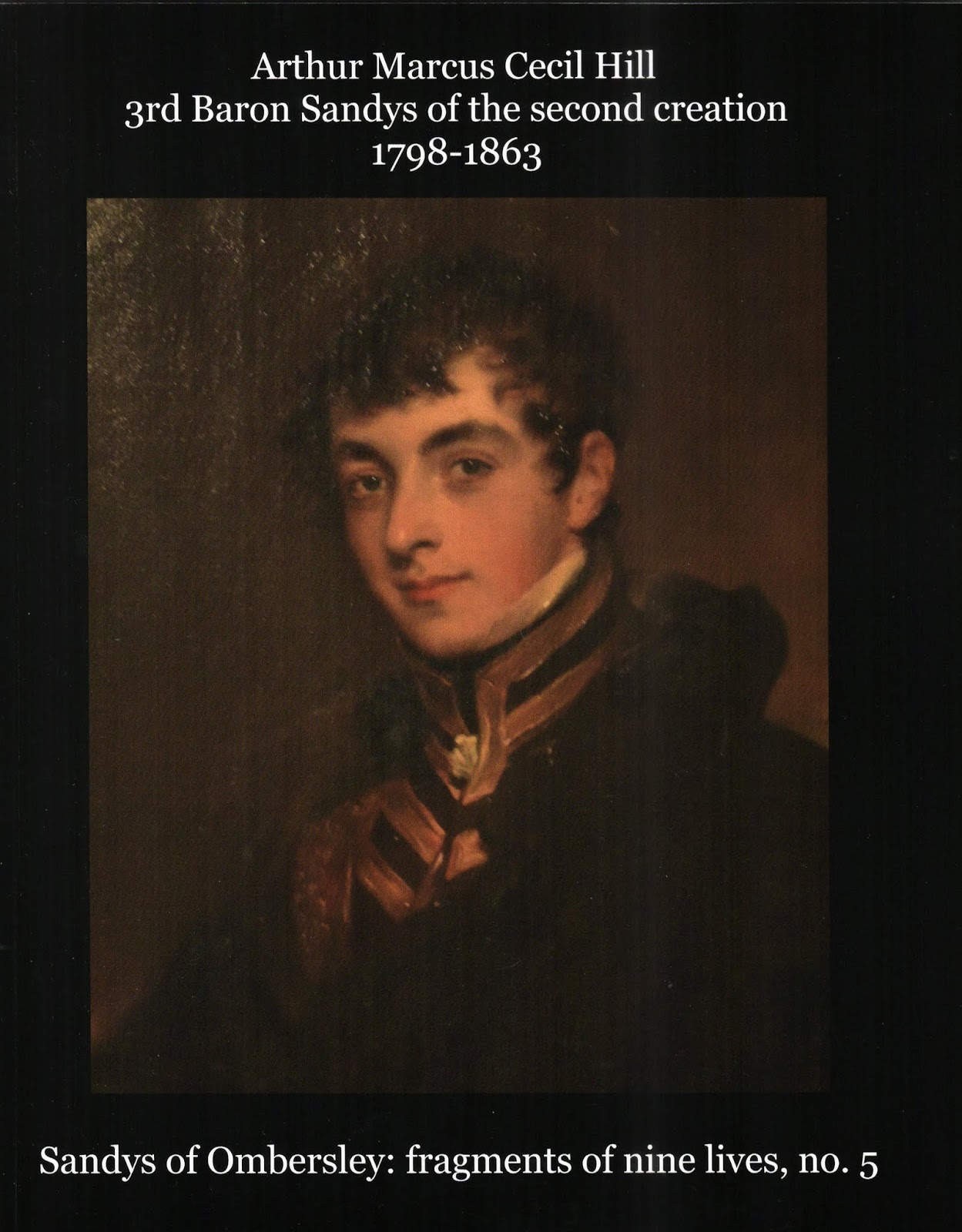
was christened Arthur Marcus Cecil Hill, and three years before he died he unexpectedly became ‘3rd Baron Sandys of the second creation’ with a country seat at Ombersley Court in Worcestershire. He was a younger son; his father was a cousin of the Duke of Wellington. By 1822 Marcus was already a promising junior member of the diplomatic corps, having served an apprenticeship in Madrid under the kindly eye of the British ambassador, Sir Henry Wellesley – Wellington’s brother. 

He had then been fortunate to attract the attention of Lord Castlereagh, the foremost British diplomat and politician of his generation. Marcus referred to him as ‘my patron’, working for him while Castlereagh was Foreign Secretary, and afterwards criss-crossing Europe in the years following the Congress of Vienna. He was a young man of charm and loyalty, laying the foundations for what could have been a notable career.

But in August 1822, Castlereagh committed suicide. Marcus was devastated, suddenly losing not just the man who had become his friend and mentor but the man under whom, so he had assumed, his future career would have been assured. Fortune, however, had not deserted him: his mother wrote to Wellington, pleading with him to find a new position for her son. His Grace submitted gracefully, and before long Marcus found himself in Italy as a member of the Duke’s diplomatic entourage. 

In early December, with the winter weather closing in, it was time to head home, but Wellington needed to return via Paris. He planned to travel from Turin via the Mont Cenis pass, which Napoleon had opened up in 1806 and which soon became the most popular route between Italy and France. Marcus, however, with the optimism of youth (he was 24) thought he could get to Paris before the Duke if he took a different route. Hoping to impress his new master, he reached Domodossola, engaged a carriage and horses and headed for the Simplon Pass.  He had hardly started, however, before the snow made further progress impossible, the postilions (as he later wrote to a friend) refused … 

‘… all my bribes and did not wish to risk either their lives or mine in view of the dangers of the journey I was proposing. I thought they were cowards whereas in fact they were just being sensible, and I had to reconcile myself to spending the night in my carriage, waiting for day.’

Next morning the snow was already four feet deep. Duly chastened, he trudged back into Domodossola, afterwards reporting laconically that he had passed the body of a peasant who had frozen to death overnight.

***
British diplomacy and European history after the Congress of Vienna are definitely ‘not my
period’. But I have been fascinated by a book about Marcus Hill, lent by a friend who asked my opinion of it. The book is number 5 in a series entitled Sandys of Ombersley: Fragments of Nine Lives. They are all compiled by Martin Davis, the Ombersley Court archivist. 

The word ‘fragments’ is important here: essentially the books bring together the source
material – letters, portraits and other documentary evidence, with enough linking commentary to provide narrative coherence – that an historian or future biographer would find useful. The formula works very well, inviting readers to turn biographer themselves; certainly, I have found myself asking questions a biographer needs to ask – ‘What was Marcus Hill really like? Would he have deemed his own life a success or failure? He came to hate the diplomatic world, ‘the chicaneries of the profession, the continual state of change and uncertainty to which it is exposed’ and longed instead for ‘a quiet enjoyment of a country life in England where alone that state of happiness is known’. Later, after a long spell as MP for Evesham he decided not to stand again, pleading the demands of ‘a numerous and youthful family’. True enough: he had fathered ten children.

What caught my imagination first, of course, was his night in Domodossola. Then, once I’d made the connection between his experience there and mine, the phrase ‘ this frail travelling coincidence’ came to mind. You’ll find it in the last stanza of Philip Larkin’s fine poem, The Whitsun Weddings. The traditional Whitsun Bank Holiday was abolished in 1978, and Whitsuntide as a season in the Anglican year has all but vanished too; so just for the record I post this on Whit Sunday, 31st May 2020.  

Adrian Barlow

For much more about the Sandys family and Ombersley Court, I recommend The Sandys Story and The Sandys Story Blog.

I have written before about my debt to archivists: In Praise of Archivists.

Illustrations:

(Fig.i) Domodossola, the railway station

(Fig. ii) Ombersley Court

(Fig.iii) Martin Davis (ed.) Arthur Marcus Cecil Hill, 3rd Baron Sandys of the second creation, 1798-1863 (Blurb Publishing, 2019)

Sunday, 19 April 2015

In London, with Charles Lamb

I have found myself in London for the past two Saturdays, a rare occurrence. Charles Lamb called London ‘a pantomime and a masquerade’, and he wasn’t wrong. In Covent Garden last Saturday, street performers were everywhere: fire-eaters, conjurors, mime artists who present the disconcerting illusion of actually sitting or walking on thin air. Fewer musicians than I remember: the finest buskers I ever heard were in Covent Garden: two men dressed in tail coats and playing con brio Handel’s Water Music, arranged for Souzaphone and penny whistle. But all human life was there, just as Lamb once described it in a letter to Wordsworth:

'I have passed all my days in London, until I have formed as many and intense local attachments as any of you mountaineers can have done with dead Nature. The lighted shops of the Strand and Fleet Street; the innumerable trades, tradesmen, and customers, coaches, wagons, playhouses; all the bustle and wickedness round about Covent Garden […] the crowds, the very dirt and mud, the sun shining upon houses and pavements, the print shops, the old bookstalls, parsons cheapening books, coffee houses, steams of soups from kitchens, the pantomimes – London itself a pantomime and a masquerade.' (30 January 1801)

And today, a week later, I am in Bloomsbury, here to give a lecture on Charles Lamb. Elia himself
might have thought Queen Square, where I have been walking for a while this morning, a bit too quiet; indeed, I have it almost to myself, which suits me very well. Queen Square lies between Southampton Row and Great Ormond Street, one side of it lined with hospital buildings - neurological, neurosurgical and homeopathic. The Children’s Hospital is just beyond.  At the east end of the square is a building I once knew well. Looking more like an embassy than a hospital (there is an imposing, if somewhat Ruritanian, achievement of arms above the front door) is the Italian Hospital. The nurses are (or were) Italian nuns: my mother was once a patient there for a month. She said the sisters were the kindest nurses she’d ever encountered.

Outside the hospital is a paved area, and here someone has been busy: the flagstones are covered with poetry, chalked by a visitor who must have spent much of the night composing a poem in what W.H. Auden once called ‘a rapture of distress’. He raps of hunger and of meditation, of the kindness of strangers and the coldness of the stones; but he ends with this question: 

Who be the beggar and what the beggar be?
I walk within my own authority
There is no body that stands over me
So who be the beggar and what the beggar be?

Charles Lamb would have delighted to read this. In ‘A Complaint of the Decay of Beggars in the Metropolis’ he lamented attempts by the City authorities to ‘extirpate the last fluttering tatters of the bugbear Mendicity from the metropolis’. Of the old beggars he says, ‘There was a dignity springing from the very depth of their desolation; as to be naked is to be so much nearer to the being a man, than to go in livery’.

Poetry becomes Queen Square: Faber & Faber used to have their headquarters here, and in the gardens – fenced off but open from dawn to dusk – I find a circular basin commemorating the Queen’s Silver Jubilee of 1977. Engraved on the paving stones beneath it, but dust-filled and fading already, I make out this verse:

IN TIMES WHEN NOTHING STOOD
BUT WORSENED OR GREW STRANGE
THERE WAS ONE CONSTANT GOOD
SHE DID NOT CHANGE                         LARKIN

I like the confident use of the poet’s surname – an echo perhaps from a time when to add ‘Philip’ would have been unnecessary. And walking round the basin I find another verse:

A NATION’S A SOUL
A SOUL IS A WHEEL
     WITH A CROWN FOR A HUB
TO KEEP IT WHOLE                  HUGHES

Larkin and Ted Hughes, Faber poets both. And there is more poetry to be found all around the garden: the paths are lined with seats, each one given in memory of someone who had either been a doctor working in one of the hospitals overlooking the Square, or a patient or a resident. Two commemorate victims of the Trident air crash of 1972, another a more recent victim of the London bombings. Several contain quotations: ‘Memory holds a seat’ says one, echoing Hamlet. Another quotes Samuel Beckett:

Ever failed. No matter. Try again. Fail again. Fail better.

Close by, a bench given in memory of one who died young offers a plaintive comment: “The question ‘Why?’ will always remain unanswered.” Then, further on, a three-month old child who died perhaps in Great Ormond Street: the boy’s name was Elias. I think of Lamb again. Elia was his alias.

I was quite wrong to think Queen Square might not have appealed to him. Lamb loved children, and wrote about them with an affection all the more touching because he had none of his own.  Coram’s Fields and the Foundling Hospital, where mothers queued to hand in for safe keeping the children they could not keep themselves, are only a block away. Charles Lamb and his sister Mary once adopted an orphan girl. He knew about separation and loss – ‘All, all are gone, the old familiar faces’ he wrote in his one still-famous poem   – and in the middle of Queen Square today stands a sculpture of a mother and baby, clinging to each other, the child twisting a tiny finger under the strap of its mother’s dress, resisting all possibility of separation.  In Dream Children: A Reverie Lamb dreams he is indeed a father, surrounded by a loving family. The waking from this dream is as hard for the reader as for Elia himself. The children fade and, fading, seem to whisper to him:

We are nothing; less than nothing, and dreams. We are only what might have been.

It’s time to go and give my lecture.

Adrian Barlow

I have written about Lamb once before, in Charles Lamb and Cambridge, and this was the subject of the lecture I gave.

[illustrations: (i) A mime artist in Covent Garden; (ii) Street sign in Queen Square (iii) Sculpture by Patricia Finch (2008) in the Garden of Queen Square

Text and illustrations © the author