Monday, 17 August 2020

Paul Nash and the view from Queen Alexandra Mansions

Margaret Odeh, an old girl of Cheltenham Ladies College, was a prominent figure in the suffragist movement and a campaigner for social justice and women’s welfare. From school she went up to Oxford. Then, in 1913, aged 24, Margaret moved into Flat 176 of the newly-built Queen Alexandra Mansions (on the northern edge of Bloomsbury), fell in love with a young painter named Paul Nash, and married him in December 1914. Nash spent much of the next four years in France and Belgium, first as a soldier and latterly as an official War Artist. 


In the twenties and thirties, Margaret and Paul travelled much between various places both in England and abroad, but they kept their London flat as a pied à terre, where the view from their north-facing sitting room window fascinated Nash. This view was the subject of a series of oil paintings and drawings dating from 1927 until 1934, by which time their view of Sir George Gilbert Scott’s masterpiece – the Midland Grand Hotel that acts as a façade to the station behind – had been entirely blocked by the recently erected Camden Town Hall.


St. Pancras, London (1927), which belongs to The Wilson, Cheltenham Art Gallery and Museum, is probably the earliest and certainly the most intimate of these images. At first glimpse indeed it seems almost touchingly simple: a jaunty bunch of small flowers, though of rather muted colours, sits in an earthenware jug placed up against a sash window. Through the panes of this window can be seen, on the left, the entrance to the steps leading to the Midland Grand Hotel’s main entrance and, on the right, the sweep of the drive turning off the Euston Road towards the arch through which taxis could convey their fares up to the ticket office of the old station. The view is entirely devoid of people or vehicles. Only the flowers and the sash window stand between Paul Nash and all stations to Bedfordshire, though nowadays of course it is the London terminus for Eurostar.


The flowers themselves reflect all the colours used by the artist to paint the building across the road; or should that be vice versa, for what really is the subject of the painting? Its title suggests the station, but without the title, wouldn’t one call this a still life: jug of flowers, window, distant view? The building in the background is, frankly, only lightly sketched.


As Nash has painted this picture, you’d think the window of Flat 176 must have looked straight out across the Euston Road towards the entrance to the station forecourt. It is worth noting that the only architectural feature painted in any detail is the smallest but also the one closest to the artist: the carved stone finial on top of the single gatepost. You can tell from the slight angle of the window frame that Paul Nash was not standing exactly in front, but to the right, of the jug of flowers: as he looked out, he must have been standing square on to the gatepost.


But Queen Alexandra Mansions do not stand directly opposite St Pancras – and never did. When Nash and his wife gazed out of their window they looked across Bidborough Street, over the roof of an undertaker’s premises and down onto some small gardens which bordered Euston Road. But for Nash in 1927 it was as if none of that got in the way. 


Only in 1929 when the coffin shop was demolished and the gardens were cleared to make way for

hoardings to enclose the space where the new town hall was to be built, did Paul and Margaret Nash feel a sense of impending loss. In that year he abandoned the still life and the sash window. Instead he stared with growing dismay straight at the increasingly surreal scene unfolding before him: skeletal billboards being erected; high hoardings presenting a barrier between him and the architecture that had so fascinated him. Signs of decay began to appear – an outsize window from the hotel façade lying at a crazy angle, the footpath leading up to the arch now reimagined as a sleek silvery tongue; only the solitary gatepost with its trefoliated finial still standing as a reminder of how things used to be. Nash painted all this in Northern Adventure (1929), a picture that stands in stark opposition to St Pancras, London. 


Looked at another way, you could argue that the St Pancras building now looks like a flimsy stage set ready to be dismantled, its walls no more than painted canvas and the discarded window outside just one more prop to be stored away. Nash’s own window, the window of the flat he shared with his wife in Queen Alexandra Mansions, has also been discarded: in this picture, it simply doesn’t appear.


Eventually, when Camden Town Hall had risen to block their view of St Pancras entirely, it was time for Margaret and Paul to move. They gave up their flat in 1934. Today there is a blue plaque to commemorate Paul’s time living in Queen Alexandra Mansions, but of Margaret (whom Paul always called Bunty) there is no mention. Which is a shame, for she was a remarkable woman in her own right.


Footnote

I have never lived in London. I doubt if I have ever spent more than three consecutive nights in the city, but I know my way around some parts pretty well, especially the Euston Road, St Pancras and Kings Cross areas. These are the stations where – at different times of my life – I have arrived and departed from or to Birmingham, Durham, Bedfordshire, Cambridge and Paris. And, as it happens, I know Queen Alexandra Mansions well, too, because one of my oldest friends, Mary Whitty, lived there for many years. Like Margaret Odeh, Mary was a remarkable woman with wide interests, a strong sense of social justice and a love of art, literature and travel. She was always loyal to her friends. Had she and Paul Nash’s wife been neighbours in Queen Alexandra Mansions, I think they would have got on well. Mary died in 2018, and is much missed by many people.  


Adrian Barlow


This post is an expanded version of my account of Paul Nash’s painting, St. Pancras, London, which you can read on the website of the  Friends of The Wilson, Cheltenham Museum and Art Gallery.


I recommend an excellent blog, Inexpensive Progress, written by Robjn Cantus.  This includes a fully illustrated essay about Paul Nash and St. Pancras, which has provided some of the information I have included above.


I have written before about King’s Cross and St. Pancras:

King’s Cross in All Its Glory

King’s Cross and EM Forster


Wednesday, 8 July 2020

Trollope’s Area Steps

In the weeks since Lockdown began my wife and I have walked, to our amazement, considerably more than 500 miles in and around Cheltenham: main roads, side roads, avenues of lime trees – I had never realised before this year how strong and sweet the scent of Tilia platyphyllos (broad-leaved linden) can be – and footpaths through woods, through fields or along ancient tracks such as the Salt Way across Cleeve Hill or the wooded walks on top of Crickley Hill. Ivor Gurney, writing from France during the First World War, remembered both: 

 You hills of home, woodlands, white roads and inns 
That star and line our darling land, still keep 
 Memory of us; for when first day begins 
We think of you and yours – 
 Trees, bare rock, flowers 
Daring the blast on Crickley’s distant steep. (Crickley Hill) 

Gurney’s ‘darling land’ was always Gloucestershire. 

One of the delights of these walks has been exploring lanes and footpaths we’d never found before, some quite close to home. Opposite Cheltenham College Chapel is a walled passageway I’m particularly pleased to have discovered: Olio Lane. As you enter it from Sandford Road there is a white gate, bearing a name I first misread as Bone House. Could there really be an ossuary behind the wall? I wondered nervously. In fact, it read Boyne House – one of the College boarding houses, and possibly (according to the College itself) the earliest school boarding house of the Victorian era. 

I like to think that the novelist Anthony Trollope would have known Olio Lane: he once rented a house in
Paragon Buildings, the other side of the wall. Did he know that ‘olio’ means ‘a medley or hotch-potch’ (according to Dr. Johnson) and comes from ‘Ollo’, the Spanish for a hot-pot or stew? Probably. Trollope enjoyed both words and food, his 47 novels proclaiming the former and his generous girth the latter. Why isn't there a blue plaque for Trollope in Cheltenham? There should be: his novels tell us a lot about the social nuances of the town in the mid 19th century. Chapter 15 of Can You Forgive Her? (1864-5) is entitled ‘Paramount Crescent’, and in Trollope’s day, the paramount crescent in Cheltenham was Royal Crescent, where the young Princess Victoria had stayed briefly in 1830. 

Like so much of Cheltenham built in the last twenty years of the 18th century and the first twenty of the 19th, the houses of Royal Crescent were not intended to be private houses; they were designed as lodgings rented by people coming to the town for a few weeks, or for a season, to take the Spa waters that had become a major tourist attraction, ever since the visit of King George III in 1788. At No. 3, Paramount Crescent, in Trollope’s novel, lived the widowed Lady Macleod who ‘occupied a very handsome first-floor drawing room, with a bedroom behind it, looking over a stable yard.’ All the details here count; the first floor, the piano nobile, has the largest reception room with tall windows opening onto a balcony. Such a room would certainly have been (in the language of lettings agents of the 1860s) ‘very handsome’. On the other hand, Trollope is clear that Lady Macleod has had to make sacrifices: 
 
The vicinity of the stable-yard was not regarded by the tenant as among the attractions of the house, but it had the effect of lowering the rent, and Lady Macleod was a woman who regarded such matters. So she pinched herself, and inhaled the effluvia of the stables …. 

 Cheltenham was evidently on Trollope’s mind at this time. In the same year that he published Can You Forgive Her?, he produced Miss Mackenzie, a novel about ‘a very unattractive old maid, who was overwhelmed with money troubles’ (his own words) even though she was only thirty five and by no means as unattractive as his dismissive comment suggested. At the start of the novel, Margaret Mackenzie comes unexpectedly into some money, and with this new-found (but short-lived) independence she decides to move to Cheltenham – now called by Trollope Littlebath. She takes furnished lodgings in the Paragon, but this is not the same Paragon Buildings in which Trollope himself had lodged with his family a dozen years earlier: 

 It is a long row of houses with two short rows abutting from the ends of the long row, and every house in it looks out upon the Montpelier [sic] gardens. If not built of stone, these houses are built of such stucco* that the Margaret Mackenzies of the world do not know the difference. Six steps, which are of undoubted stone, lead up to each door. The areas are grand with high railings. 

 Six steps because the ground floors are raised above street level to allow room for a basement below. The more steps, the more elevated the ground floor and the more light that can seep down into the area (the narrow space at the foot of the area steps leading to the servants’ entrance into the kitchen and staff quarters) and through the basement windows. These days, though, the area steps more often lead to the front doors of what are euphemistically called Garden Flats. 

Social distancing – though the phrase of course not then current – was understood rather differently in Trollope’s time: going up the steps to the front door or down into the area below street level was the physical expression of the idea of living and working above or below stairs. Tempora mutantur: words and expressions likewise change with the times. One street I had never walked down before Lockdown was Eldorado Road, its name reminding me of nothing so much as ice cream or the ill-fated TV soap opera of the early 1990s. But the reality was very different: sober redbrick late-Victorian villas, standing well back from the road and guarding their privacy behind high privet hedges – a perfect architectural statement of social distancing. 

© Adrian Barlow 

*Stucco is a cement render, covering external brick walls on buildings all over Cheltenham, which can be painted or sculpted to look like stone. The houses of Royal Crescent, illustrated above, are all decorated using this technique. 

 Illustrations: 

(fig.1) The area steps and railings of No.1 Royal Crescent, the house where Princess Victoria stayed in 1830, seven years before her accession.
(fig.2) Anthony Trollope 
(fig.3) Royal Crescent, Cheltenham, a photograph from the Francis Frith archive, Copyright Victoria & Albert Museum. NB The oil streetlamp with a miniature chimney pot on top. 

 I have blogged about Anthony Trollope before: 

 My book Extramural: Literature and Lifelong Learning (Lutterworth Press 2012) contains a chapter about Trollope’s Barchester Novels: ‘Trollope and Religious Controversy’, pp.64-80.

Thursday, 11 June 2020

Reading Stained Glass: Corpus Christi and the Pelican

‘A wonderful bird is the pelican …’* Anyone who only knew about pelicans from this celebrated limerick might be forgiven for smiling at the mere thought of these rather bizarre birds. But the pelican, along with the dove and the eagle, is one of the most important symbols in Christian iconography. I believe his earliest appearance in stained glass - though from now on I must say ‘her’, not ‘his’ – is in Chartres Cathedral (fig.ii) in the 13th century ‘Redemption window’ where a pelican, with wings outstretched, pecks at her breast to allow her chicks to feed on her blood. The seated king, looking on, is David, and in his hand he holds a long scroll with the inscription ‘Similis factus sum pellicamo’ (from Psalm 102: ‘I am become like the pelican in the wilderness’). So this one image both looks back to the Old Testament, foreshadowing of the loneliness of Jesus in the wilderness, and forward to the crucifixion and the redemptive shedding of Christ’s own blood. The pelican becomes established as the symbol of Corpus Christi, the body [and blood] of Christ. The feast of
Corpus Christi is always observed on the second Thursday after Whit Sunday. In the later middle ages, this was an important public holiday, celebrated with processions, pageants and mystery plays performed by members of the different Guilds. All long gone, now, but the pelican remains.


From then until now, the elements of the symbol – the bird, the blood, the chicks and the nest –

hardly change. They appear throughout Europe not only in stained glass but in stone and wood carving too, for instance on a 15th century misericord in Cartmel Priory (Cumberland; fig. iii).


Oxford and Cambridge each have a Corpus Christi College, and an heraldic pelican appears on the arms of both. At Cambridge the college was founded in 1352 jointly by the Guild of Corpus Christi and the Guild of the Blessed Virgin Mary, hence the shield is quartered between the pelican and the lilies that are the symbol of Mary. At Oxford, Corpus Christi was founded in 1517 by Richard Fox, Bishop of Winchester, whose own crest was a golden pelican. There is a splendid 16th century sundial in the College quad, surmounted by a pelican in her piety.


The pelican is one of the very few pre-Reformation religious symbols to have survived the upheavals in English church life during the 16th and 17th centuries. Later, indeed, she enjoyed a dramatic revival in stained glass during the 19th century. A remarkable image in an early (1864) window by  Morris & Co at Bradford Cathedral depicts the pelican in graphic, almost comical, close-up (fig.iv:) staring – or glaring? –  down her beak at the first rubber-necked chick, she struggles to steer a glob of blood towards his gaping mouth while the other two wait eagerly for their turn. 


The range of textures and patterns in this image is worth our attention. At the base flowers and grass reach up around the neatly woven wicker basket of a nest in which the downy chicks appear half submerged in hay. The dark blue background is an intricate pattern of tiny quatrefoils created out of a lattice work of black lines and dashes, all painted on by hand. Looking carefully, you can see one or two places where the design goes wrong. At the top the wavy grey-green clouds are actually the only indication that this is a religious symbol at all: clouds represented like this, though rather less freehand than here, always denoted in medieval glass the clouds of heaven and William Morris was careful to follow that precedent. The artist who designed this window was Morris’s close friend, Philip Webb.  


At Much Marcle in Herefordshire she appears above the Crucifixion scene in the church’s East

window (fig.v), designed in 1877 for Charles Eamer Kempe by Wyndham Hope Hughes. This design clearly shows Kempe’s debt to the Chartres pelican, but with the rather neat added touch that the nest is drawn as the cup of an acorn and the bird perches on a branch of oak leaves.  


No artist in the 19th century paid more attention to the pelican than Kempe, for whom the bird had a special significance. That Kempe often signed his windows with a wheatsheaf – one of the elements of his family’s coat of arms – is well known; much less well known is that the crest on top of the Kempe shield depicts a pelican pecking at a wheatsheaf. For Kempe, this image had a key symbolic significance. He had originally hoped to be ordained as an Anglican priest, but a severe stammer prevented this and after leaving university he decided to develop a career in church decoration and stained glass. Throughout his career he believed that he had a special vocation to teach and indeed to preach through his windows. What he could not say from the pulpit because of his stammer, he could express though stained glass.  It is no surprise that the poet George Herbert meant a great deal to him:


Doctrine and life, colours and light, in one

            When they combine and mingle, bring

A strong regard and awe; but speech alone

            Doth vanish like a flaring thing …. (‘The Windows’)


He came indeed to see the wheatsheaf and the pelican, his personal crest, (fig.vi) as an endorsement of his vocation, for together they are emblematic of the Eucharist – the wheatsheaf representing the bread and the pelican, the wine. No other stained glass designer invested the pelican with greater presence, nor saw the bird so clearly as the embodiment of Christ. Whenever you see a pelican in a window, look also for the text accompanying it. If this reads ‘Ihesus pelicanus noster’ (Jesus our Pelican; fig.i - see above) the window is by Kempe.


© Adrian Barlow


*A wonderful bird is the pelican: 

His bill can hold more than his belly can.

He can keep in his beak

Enough food for a week

But I’m blowed if I know how the hell he can!

              Dixon Lanier Merritt (1910)


You can read more about the significance of the pelican in my book, Kempe: the Life, Art and Legacy of Charles Eamer Kempe (2018)


Illustrations:

Fig. i:  Pelican in her Piety by John Carter for C.E. Kempe, in St Botolph’s Church, Cambridge, 1889

Fig. ii: King David and the Pelican in her Piety, Chartres Cathedral, 13th century

Fig. iii: Pelican in her Piety, carved misericord seat in Cartmel Priory, 15th century

Fig.iv: Pelican in her Piety (by Philip Webb, for Morris & Co.) Bradford Cathedral, 1864

Fig v: Pelican in her Piety, by Wyndham Hope Hughes for C.E. Kempe, St Bartholomew’s Church, Much Marcle, 1877

Fig.vi: Kempe’s Bookplate, depicting the Pelican and the Wheatsheaf


All photographs © the author.


Sunday, 31 May 2020

A ‘frail travelling coincidence’: Domodossola and The Whitsun Weddings.

Marcus Hill and I have only one thing in common: we’ve each spent an uncomfortable night at Domodossola, an Italian town high in the Piedmont Mountains close to the border with Switzerland. We were both trying to get to Paris from Italy, as quickly as possible. This happened to me ten years ago. To Marcus, it happened in 1822. 

My story first. We were a party of five, making our way by a devious overland route from Venice to Paris – our flights back to England having been disrupted by the volcanic ash eruption of April 2010. Hoping (vainly!) that from Paris we’d catch the Eurostar to London, we had managed to buy a string of local train tickets from Treviso to Vicenza, Vicenza to Milan, Milan to Domodossola, waiting there overnight before catching an early train through the Simplon Pass to Geneva, and on eventually to Paris. 

We arrived at Domodossola almost at midnight. It was raining hard. Thankful to find a café in the Station Square still just open, we had a quick sandwich and beer but were soon turned out into the rain again, heading back to the station. Which was now closed: all lights out, all loos locked and the waiting room colonised by a group of barelegged tramps whose trousers were steaming over the heating pipes. The scene was not inviting. The five hours we sheltered on that platform live in my memory as the longest, coldest, wettest night of my life.

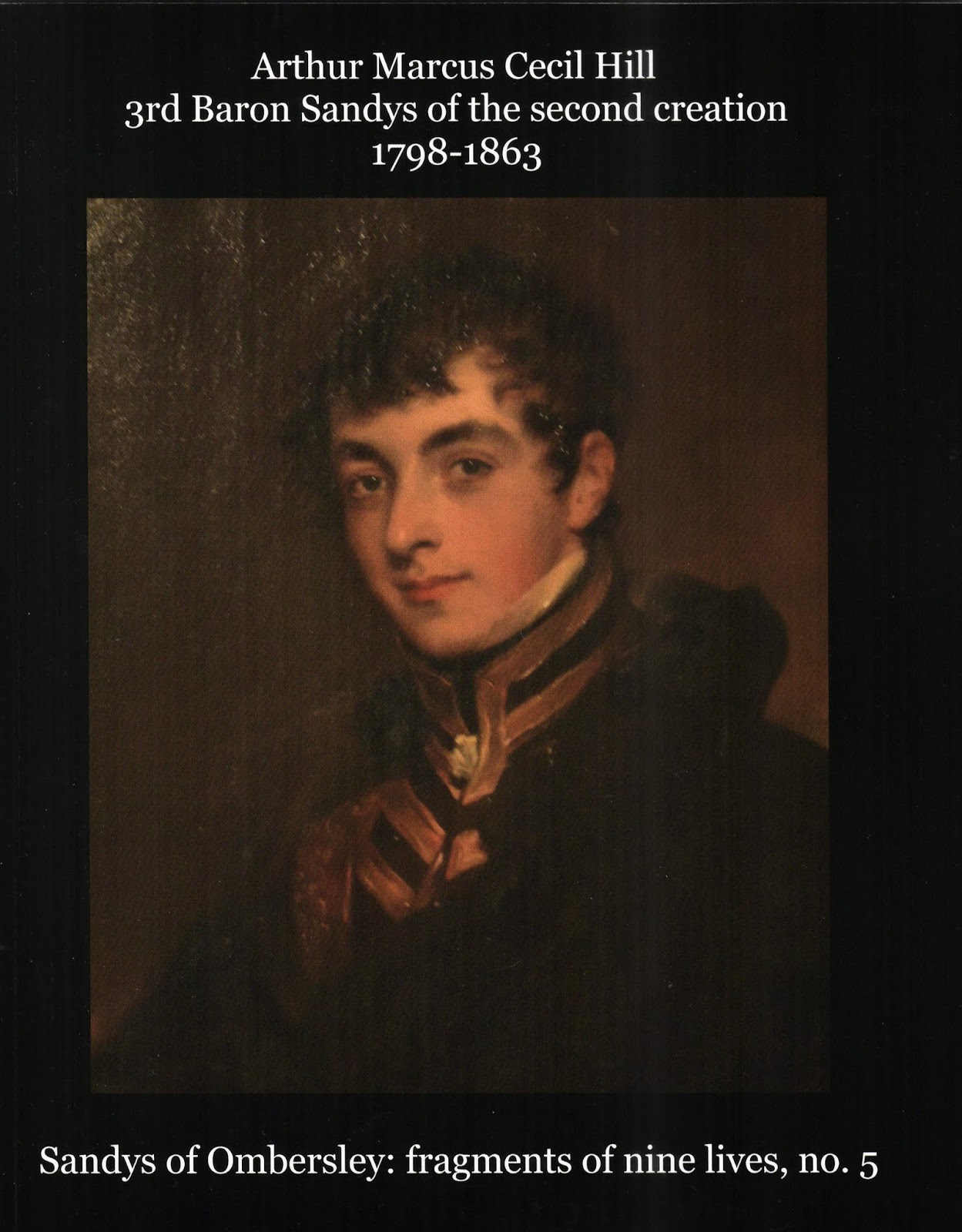
Now Marcus Hill. I begin with his full name and title, which add something to the story. He
was christened Arthur Marcus Cecil Hill, and three years before he died he unexpectedly became ‘3rd Baron Sandys of the second creation’ with a country seat at Ombersley Court in Worcestershire. He was a younger son; his father was a cousin of the Duke of Wellington. By 1822 Marcus was already a promising junior member of the diplomatic corps, having served an apprenticeship in Madrid under the kindly eye of the British ambassador, Sir Henry Wellesley – Wellington’s brother. 

He had then been fortunate to attract the attention of Lord Castlereagh, the foremost British diplomat and politician of his generation. Marcus referred to him as ‘my patron’, working for him while Castlereagh was Foreign Secretary, and afterwards criss-crossing Europe in the years following the Congress of Vienna. He was a young man of charm and loyalty, laying the foundations for what could have been a notable career.

But in August 1822, Castlereagh committed suicide. Marcus was devastated, suddenly losing not just the man who had become his friend and mentor but the man under whom, so he had assumed, his future career would have been assured. Fortune, however, had not deserted him: his mother wrote to Wellington, pleading with him to find a new position for her son. His Grace submitted gracefully, and before long Marcus found himself in Italy as a member of the Duke’s diplomatic entourage. 

In early December, with the winter weather closing in, it was time to head home, but Wellington needed to return via Paris. He planned to travel from Turin via the Mont Cenis pass, which Napoleon had opened up in 1806 and which soon became the most popular route between Italy and France. Marcus, however, with the optimism of youth (he was 24) thought he could get to Paris before the Duke if he took a different route. Hoping to impress his new master, he reached Domodossola, engaged a carriage and horses and headed for the Simplon Pass.  He had hardly started, however, before the snow made further progress impossible, the postilions (as he later wrote to a friend) refused … 

‘… all my bribes and did not wish to risk either their lives or mine in view of the dangers of the journey I was proposing. I thought they were cowards whereas in fact they were just being sensible, and I had to reconcile myself to spending the night in my carriage, waiting for day.’

Next morning the snow was already four feet deep. Duly chastened, he trudged back into Domodossola, afterwards reporting laconically that he had passed the body of a peasant who had frozen to death overnight.

***
British diplomacy and European history after the Congress of Vienna are definitely ‘not my
period’. But I have been fascinated by a book about Marcus Hill, lent by a friend who asked my opinion of it. The book is number 5 in a series entitled Sandys of Ombersley: Fragments of Nine Lives. They are all compiled by Martin Davis, the Ombersley Court archivist. 

The word ‘fragments’ is important here: essentially the books bring together the source
material – letters, portraits and other documentary evidence, with enough linking commentary to provide narrative coherence – that an historian or future biographer would find useful. The formula works very well, inviting readers to turn biographer themselves; certainly, I have found myself asking questions a biographer needs to ask – ‘What was Marcus Hill really like? Would he have deemed his own life a success or failure? He came to hate the diplomatic world, ‘the chicaneries of the profession, the continual state of change and uncertainty to which it is exposed’ and longed instead for ‘a quiet enjoyment of a country life in England where alone that state of happiness is known’. Later, after a long spell as MP for Evesham he decided not to stand again, pleading the demands of ‘a numerous and youthful family’. True enough: he had fathered ten children.

What caught my imagination first, of course, was his night in Domodossola. Then, once I’d made the connection between his experience there and mine, the phrase ‘ this frail travelling coincidence’ came to mind. You’ll find it in the last stanza of Philip Larkin’s fine poem, The Whitsun Weddings. The traditional Whitsun Bank Holiday was abolished in 1978, and Whitsuntide as a season in the Anglican year has all but vanished too; so just for the record I post this on Whit Sunday, 31st May 2020.  

Adrian Barlow

For much more about the Sandys family and Ombersley Court, I recommend The Sandys Story and The Sandys Story Blog.

I have written before about my debt to archivists: In Praise of Archivists.

Illustrations:

(Fig.i) Domodossola, the railway station

(Fig. ii) Ombersley Court

(Fig.iii) Martin Davis (ed.) Arthur Marcus Cecil Hill, 3rd Baron Sandys of the second creation, 1798-1863 (Blurb Publishing, 2019)

Thursday, 21 May 2020

Reading Stained Glass: Ascension

The Ascension is a difficult subject for stained glass artists. For a start, records are sketchy, Matthew and John making no mention of it in their Gospels. The most detailed reference (all of sixteen words long) is actually in the Acts of the Apostles, where the location is given as the Mount of Olives. Luke records that here Jesus left his last instructions to his followers and then, ‘while they beheld, he was taken up; and a cloud received him out of their sight.’ 

It’s not easy to depict someone in the act of disappearing, unless they are half out of the door. In the open air, it is even harder. The first Ascension window I ever looked at closely is on display in the HospitalKirche zum Heiligen Geist at Wismar, a Hanseatic port on Germany’s Baltic coast. It’s probably late 15th century, to judge by the rounded (i.e. ‘depressed’) arch which frames the scene. This arch indeed acts like the proscenium of a theatre where seven of the apostles, plus Mary the mother of Jesus, appear downstage half facing the audience. Here is Peter, his head tonsured as tradition dictates, his hand clutching the keys – or on this occasion just the one key – of the kingdom of Heaven; here too is the fresh-faced and clean shaven St John, the beloved disciple to whom Jesus had entrusted the care of his mother. Wearing a golden robe, he stands close by her side. Their backs are already turning away from the big event still going on behind them: Jesus floating upwards, his toes just peeping out below his once-purple robe, and the rest of his body now hidden behind the billowing folds of the blue stage curtain.

Except that this isn’t of course a stage curtain at all. The artist here has tried, not quite successfully, to emulate the conventional medieval way of illustrating the clouds of heaven. They should be more delicately scalloped, almost gathered like the folds of a ruff. Stained glass is always a collaborative effort and I’m sure more than one glass painter has been at work here: the faces of the apostles on the right have a certain vigour, even some sophistication; by contrast, their hands and toes – not to mention the toes of the ascending
Christ – are, as it were, all over the place.

My second example comes from St Mary’s, Fairford (Gloucestershire); if you have never been to Fairford, you should resolve to go – as soon as you can. The church has a unique, complete set of late medieval windows, all dating between 1500-1515. The Ascension window at St. Mary’s isn’t actually a whole window: it is one light* from a four-light window depicting post-resurrection scenes, and here the artist has made full use of the exceptional difference between the height and the width of his glass ‘canvas’. At the bottom of the light, Mary and the twelve apostles (including, anachronistically, Matthias, who had not yet been chosen to replace Judas Iscariot) have been on the Mount of Olives, clustering around Jesus and listening to his final words. I have never seen another window anywhere in the world that shows the hilltop of Olivet suddenly being shot up into the sky with such force that Jesus is simply launched towards heaven. All that can be glimpsed are the soles of his feet (still bearing the marks of the nails) for the rest of him has already disappeared into the sky. It looks to me as though some of the original glass has been lost here, but I am intrigued by the dramatic cloudscape at the very top. Either these are some of the earliest examples of naturalistic, as opposed to stylised, clouds represented in stained glass or (as I suspect) they are the work of a later – even much later – glass painter or restorer. Whatever the explanation, this stormy sky is not the least of the surprises in this most surprising Ascension scene.

Finally, a window I have seen in Exeter (Devon) but, unusually, in different places at different times. I have seen it once in an exhibition in the city’s Royal Albert Memorial Museum and once in St. David’s Church. The present church was built at the start of the twentieth century on the site of an earlier church from which, I think I recall, this Ascension window was retrieved and now lives in a lightbox† in the small south transept. I cannot even say for sure who was responsible for this window, but on stylistic grounds I believe it may have been produced in the early 1860s by the London firm of Heaton, Butler and Bayne. 

My picture shows only the scene on the ground, not the full window. Jesus is just beginning his ascent and the empty space he leaves behind is emphasised by the outstretched arms of Peter, James and John – all carefully identified by their names inscribed around their haloes – offset against the deep blue void. This glass is distinguished by its rich colours: the blue and red border of the green cloak worn by the apostle on the right (St. Bartholomew, with a finely drawn face); the sumptuously patterned claret of St John’s robe, and the red and blue flowers of the strange plant beside St Peter – NB, too,  the stylised pattern of keys just hinted at on Peter’s chestnut cloak. 

Flowers and plants are everywhere among the grass: thistles, clover, daisies, pinks. And, right in the centre, the fronds of a vigorous fern point to the most unexpected feature of this (or almost any other) Ascension window. Though Christ has now gone from earth, he has left behind two clear footprints where his feet have pressed down the clover and the blades of grass on which, only a moment earlier, he had been standing. Footprints, famously, are evidence – evidence that Jesus was here and human and has left his mark to prove it. Perhaps, on this occasion, even Sherlock Holmes would have hesitated to point out that the feet are the wrong way round.  

© Adrian Barlow


* ‘Light’: in medieval architecture, a window is divided into separate lights by the vertical stone mullions. A four-light window will have three mullions.
†A lightbox is an internally illuminated box frame which can display a stained glass window.


Illustrations from the following locations:
Fig. 1: Hospital Church of the Holy Ghost, Wismar, Germany
Figs. 2 : St. Mary’s Church, Fairford 
Fig. 3: St. David’s Church, Exeter
Photographs by the author


Saturday, 9 May 2020

Guernsey: Liberation Blog 2020

Today, 9th May, is Liberation Day on the Bailiwick of Guernsey. 75 years ago a small detachment of British soldiers and sailors disembarked at St Peter Port, to be greeted with relief and rejoicing by the remains of the local population. Their arrival brought to an end five years of German occupation, the last year of which had reduced islanders and occupiers alike to near starvation. 

Liberation Day has been commemorated  ever since, and this year’s 75th anniversary should have prompted a special celebration, but Coronavirus has had the inevitable consequence that the streets of St Peter Port, the island’s harbour and main town, will seem almost empty - at least by comparison with all the preceding anniversaries.

Sarnia, chière patrie, bijou d'la maïr, 
Ile plloinne dé biautai, dans d'iaoue si cllaire 
Ta vouaix m'appeule terjous, mon tcheur plloin d'envie, 
Et mon âme té crie en poine, mes iars voudraient t'veis.

Sarnia; dear Homeland, Gem of the sea.
Island of beauty, my heart longs for thee.
Thy voice calls me ever, in waking, or sleep,
            Till my soul cries with anguish, my soul aches to weep.

I’m unable to say whether Guernsey’s inimitable patois of English and Normandy French is just a dialect, but it does no harm for mainly monoglot Brits like me to hear an alternative identity asserted through what sounds like a local language. The pride the Islanders have in the fact that they have a local language reminds me of the proud but gentle Irishman Hugh, in Brian Friel’s play Translations, who describes his native Gaelic thus:

a rich language, full of the mythologies of fantasy and hope and self-deception – a syntax opulent with tomorrows. It is our response to mud cabins and a diet of potatoes; our only method of replying to ... inevitabilities.  

It’s no coincidence that the best known novel about Guernsey in the time of war is The Guernsey Literary and Potato Peel Pie Society (2008). During the occupation, pies consisting of mashed potato, peelings, and beetroot, were first a staple and, later, a rare treat.

Many of the 2,800 Guernsey deportees found themselves interned in camps in southern Bavaria such as Biberach, though some were sent to Buchenwald.  The treatment of Islanders during the war – both those on occupied Guernsey and those deported to Germany – is still a contentious subject, but the stories of those who survived and of those who died are being carefully researched and made accessible. The island itself has become a prime site for ‘occupation archaeology’.

I was in St Peter Port myself, 10 years ago, to attend the 65th Liberation Day celebrations.  For lovers of fancy dress, the Church Parade would be hard to better. It was led by the Guernsey Concert Band, all shining braid and sounding brass; then came the Lieutenant Governor in his plumed cocked hat and the Bailiff in his ermine-fringed purple robes, each cutting a splendid figure, pursued by the Island’s senior judges and Jurats; following them, a platoon of Chelsea pensioners and a parlourful of mayors representing the towns - mostly from the north west of England - to which 5000 child evacuees from Guernsey had been dispatched in 1940. 

From near the harbour came the sound of drums. Under the gaze of Prince Albert, whose statue overlooks the slipway at which he and Victoria had disembarked in 1846, a group of happy drummers swayed and drummed to a decidedly Latin beat. This was where Pageantry segued seamlessly into Carnival: Guernsey’s own Samba Burros were paying tribute to the small band of British servicemen who had marched up this same slipway on 9th May 1945. Even the name of these crowd-pulling percussionists was apt for today: ‘Burros’ are donkeys, and in Guernsey the donkey symbolises the stubborn resistance and independence of the Islanders. One defining image of the Liberation is a cartoon showing a donkey kicking a jackbooted Nazi off the island into the sea.

Once the street processions were in full swing, I climbed away from the harbourside, away from the town, making my way up to Fort George, the garrison built in 1812. Come with me. Eventually (for the path is not obvious) I reach the Garrison Cemetery, one of the strangest cemeteries in Europe, but visited by few people – least of all perhaps on Liberation Day. It is located on a south-facing slope, with a view of the sea glimpsed between pine trees, and outside the entrance stands a Cross of Sacrifice, that familiar landmark of a Commonwealth War Graves Commission cemetery (CWGC); indeed there are a few First World War graves, including soldiers of the Royal Guernsey Light Infantry who had been wounded but managed to get repatriated and died on their home soil.  So far, so British; but what I see next is a surprise:

 111 GERMAN SOLDIERS OF THE WAR 1939-1945
REPOSE AT THIS BRITISH GARRISON CEMETERY

As I stand at the top of the cemetery slope, it is clear that the plot has been carefully landscaped: British graves on the right, German on the left. The 111 headstones of the German graves are the same height as the CWGC headstones but discreetly arched, not rounded, at the top. And presiding over the whole cemetery is a great white Germanic cross, carefully framed by banks of blue hydrangeas.

The cemetery was laid out in this way in 1963 to designs by a Stuttgart gartenarchitekt, Richard Schreiner, but I should love to know who was responsible for the greatest surprise(s) of all. Just inside the entrance, on my right, is a simple wall with a bronze door set into it. The door is decorated with relief images of people, some alone, some as couples, visiting a cemetery (small crosses are dotted at their feet). But when I open the door, expecting at least to find an opening of some kind, there is only a second door. Once I’ve opened both doors, I am confronted with a kind of triptych on which are inscribed the name, rank and dates of birth and death of all 111 German soldiers. 

Even this is not the strangest surprise. On the wall to the right of the door is another inscription, in German and English:

LEBEN LEBT JENSEITS DES GRABES
LIFE LIVES BEYOND THE GRAVE

The words are those of Edward Young, from his poem Night Thoughts (1742-1745). Why should a German memorial feature a quotation from an obscure English poet? I’ll suggest three reasons. In his day Young was greatly admired, but by the end of the nineteeth century, he had been so nearly forgotten that even Q (Sir Arthur Quiller-Couch) omitted him from his magisterial Oxford Book of English Verse (1900). Yet he was not forgotten in Germany. Young’s belief in the power of human individualism, inspiration and genius to create great works of art and science was quickly endorsed by the Sturm und Drang movement: Goethe and Schiller, in particular, admired Young’s poetry and ideas.

My second suggestion is a simple, perhaps naïve, one: that the German designers of the entrance to this British cemetery thought Young’s quotation would be both an apt and a tactful one – a conciliatory gesture, if not exactly a gesture of reconciliation.

Here is my third. I have described Young as ‘so nearly forgotten’ in England, but he was not entirely so. During the First World War, the poet Edmund Blunden treasured his copy of Young’s poems while at the Front, and quoted from them in his Undertones of War, one of the seminal texts of the Great War, published in Britain in 1928 and in translation in Germany in 1936. Although determined to be a good officer, looking after his men, leading by example, he refused to show hatred for the German soldiers against whom he was fighting. On one occasion, when he explained to colleagues ‘my convictions that the war was inhumane and useless’, a general demanded to know ‘why I wasn’t fighting for the Germans?’ to which he replied that it was only due to his having been born in England, not Germany.  Undertones was admired in Germany, and I cannot help wondering if Blunden’s admiration for Edward Young may not indirectly have played a part in the choice of ‘Leben lebt jenseits des Grabes’ for Guernsey.

Young’s words, ‘Life lives beyond the grave’, have today an unexpected and startling relevance to Blunden. It has recently been announced that a previously unpublished poem Blunden wrote in 1945 to mark Victory in Europe has been acquired by the Imperial War Museum. It is now available online and you can read it for yourself here. It was read on BBC 5 Live yesterday. The poem celebrates ‘Reunion, restoration, freedom deep and true’. You couldn’t sum up Guernsey’s Liberation Day better than that.

Adrian Barlow

I have written about Edmund Blunden before:

I have also written about the Channel Islands before:

Sunday, 3 May 2020

Still life: strange lives


In which I reflect on two paintings in The Wilson, Cheltenham’s art gallery and museum, closed like all such places in the time of Coronavirus. My account of ‘Window, Still Life’ was written during the first week of the lockdown, when we were all still wondering what lay ahead; it appeared as a short contribution to the Summer Newsletter of the Friends of The Wilson, and I reprint it here in a slightly altered form. I wrote down my thoughts on ‘Patience’ in week six of this strange half-life with its compensations as well as its griefs.

The Wilson is shut,* but a painting in the Friends’ Gallery by the Bloomsbury artist Vanessa Bell stays in my mind. It’s called ‘Window, Still Life’ (fig. i) and just now we are all living rather still lives, most of us with plenty of time for gazing out of windows. I doubt, though, if any of us have a view quite as strange, yet strangely resonant, as the scene V. BELL (the italic capitals of her signature just legible in the corner) has painted here.

At first everything seems straightforward. Close to a wide-open window stands a small table on which are positioned two bottles and an earthenware bowl. Behind the table something is propped against the wall – perhaps a canvas on a stretcher. Is this the artist’s studio, the objects on the table placed on what could be a superannuated palette? 

The room appears to be high up: through the window the painter looks out and down on the roofs of much lower buildings. But here the difficulties begin, for the roof lines suggest the houses are crowding together at impossible angles – pressing up indeed against the wall of the studio. No less oddly, a great gabled chimney stack seems to have become dislodged and now hovers between two roofs, one thatched and one tiled. What creates this disturbance is the cascade of trees, huge green boulders blocking out the sky, tumbling down a hillside and colliding with the houses that stand in their way.

So the two halves of the painting confront each other, the studio’s still life opposing the strange confusion outside. Actually, ‘observing’ would be more accurate than ‘opposing’: the two bottles – one a bouteille de vin with orange-striped label and dainty neck, the other a grey broad-shouldered demijohn – stand like a couple, looking out. Isolated behind the window they wait, watching as the chaos comes ever closer: the orange ridge tiles of the nearest roof are even now edging above the windowsill. 

How unexpectedly this image, painted in 1915 just as the long-term horror of the First World War was becoming apparent, speaks also to these our times!

*     *     *

A picture on a wall is defined – you could say, confined – by its frame. Yet  PJ Crook
frequently challenges this idea: sometimes her paintings seem to escape the boundaries of their frame; at others the frame itself becomes absorbed into the painting.  

PJ Crook’s pictures are famously full of people but this one, ‘Patience’ (1983; fig.ii), appears to encapsulate both the idea of self-isolation and the resources needed to retreat from the
world outside. A woman sits at a card table. It’s a sunny day and the door into her garden is open, but she seems content enough inside. And when she tires of the cards her piano lid is up and her music open, ready for her to play. Nor is she exactly alone: besides her cat, there are pictures on the wall – her parents, maybe, on the right, or herself as a young woman with a husband; on the left, perhaps herself when young, with a sister. Everything appears to be neatly in place, just as she wants it: the bowl of apples on top of the piano, the two vases of flowers and the clock with its swinging pendulum, her cheerful rug with its pattern of four rectangles, one inside the other.

This rug appears at first sight not to be lying flat on the carpet; but looking more carefully, we can see that actually it has been painted over the outer, bevelled frame of the picture. Now we realise that the whole room, the whole picture, embraces the frame as though it were part of the canvas. And not just that: there are frames within frames. Across the top corner of the door into the garden, there is a thin black line, the mitred joint of a double frame. This double frame further encloses the woman playing patience while conversely suggesting that her isolation is more apparent than real: the innermost frame is as it were transparent, so we see the cat’s tail through it, not over it.

The relationship between outdoors and indoors matters too. Through the open door can be seen a vista of grass, hedge, trees, clouds and sky. The same vista is presented through the window and twice again, in the picture behind the woman’s head and reflected in the mirror above the piano. In this way she is continually surrounded by the landscape outside her window, even as she is cut off from it. By choosing it for a picture on her wall, she has opted for a virtual reality – just as the people in the other two pictures are her virtual (not her real) companions. 

Structurally, this painting suggests containment, a room framed not once but three times. Yet the picture itself refuses to be confined by these frames: it spills onto, through and over them. Emblematically, therefore, the artist offers us an image not so much of self-confinement as of self-contentment. It’s taken less than two months for terms such as self-isolation and social distancing to embed themselves in our thinking and in the way we live now. This is why I find PJ Crook’s ‘Patience’ both challenging and reassuring: we would not have chosen to live like this but, accepting why we have to, we are learning how to make the best of it.

© Adrian Barlow

Fig. i: You can see a larger image of Vanessa Bell’s ‘Window: Still Life’ on the ArtUK website here.

Fig. ii: You can see a larger image of PJ Crook’s ‘Patience’ on the ArtUK website here.


*Though the Wilson is indeed shut, you can now access its latest show, SISTERHOOD, created by the  artist Danielle Salloum. This exhibition opened in the Summerfield gallery, on the 3rd floor, just before the art gallery and museum (like all others in the country) had to close. Now it has been re-presented as a provocative and often moving virtual show, comparing portraits and lives of twenty women from Trinidad and Tobago with twenty women from Cheltenham and Gloucestershire.  I strongly recommend SISTERHOOD, and you can visit it, free, here.